Did you know
Why the calories on a label never add up
Multiply the protein and carbs by four and the fat by nine, and you'll almost never land on the calories printed on the label. Fibre, rounding and digestion explain the gap.

Conner KadziolkaUpdated 3 min read

Pick up almost any package in your cupboard and try this. Multiply the protein by four, the carbs by four and the fat by nine. Add it all up. You'll usually land close to the calories printed at the top of the label, but hardly ever right on them.
I'm on a personal life mission to uncover the weirdest fun facts about the stuff we look at every day and never think twice about. This one had a pretty good answer.
in short
Multiplying protein and carbs by 4 and fat by 9 rarely matches a label's calories, because those numbers are rounded averages, fibre counts as about 2 Calories a gram, labels round, and your body doesn't absorb every calorie in foods like almonds. BetterDay's own labels use the plain 4, 4 and 9 total of the rounded grams.

Where the 4, 4 and 9 rule came from
Those numbers go back to Wilbur Atwater. He was a chemistry professor at Wesleyan University in Connecticut, and the USDA calls him the father of modern nutrition research in the United States. Alongside his copper room, he used a steel container called a bomb. He'd put food inside, sit the bomb in water, burn the food and measure how much the water warmed up.
His numbers came out at about 4.1 Calories for a gram of protein and 9.3 for a gram of fat. Labels round those to 4 and 9 and give carbs a 4 as well, and Canada's food inspectors still use the same numbers today, plus 7 for alcohol. He also worked out that a whole pound of turnips has just 139 Calories.

Labels count fibre at 2 Calories a gram, not 4, and round their numbers
Fibre sits inside the carbohydrate line on a Canadian label, so your math gives it 4 Calories a gram like any other carb. The CFIA, Canada's food inspection agency, tells food makers to count it at 2. Fibre from wheat bran gets just 0.6. So a package with 10 grams of fibre can print 20 fewer Calories than your math, and the label is still right.
Labels round, too. The CFIA's own example is a macaroni and cheese that works out to 447 Calories, and the label says 450. The grams are rounded as well, so multiplying them out was never going to land exactly.
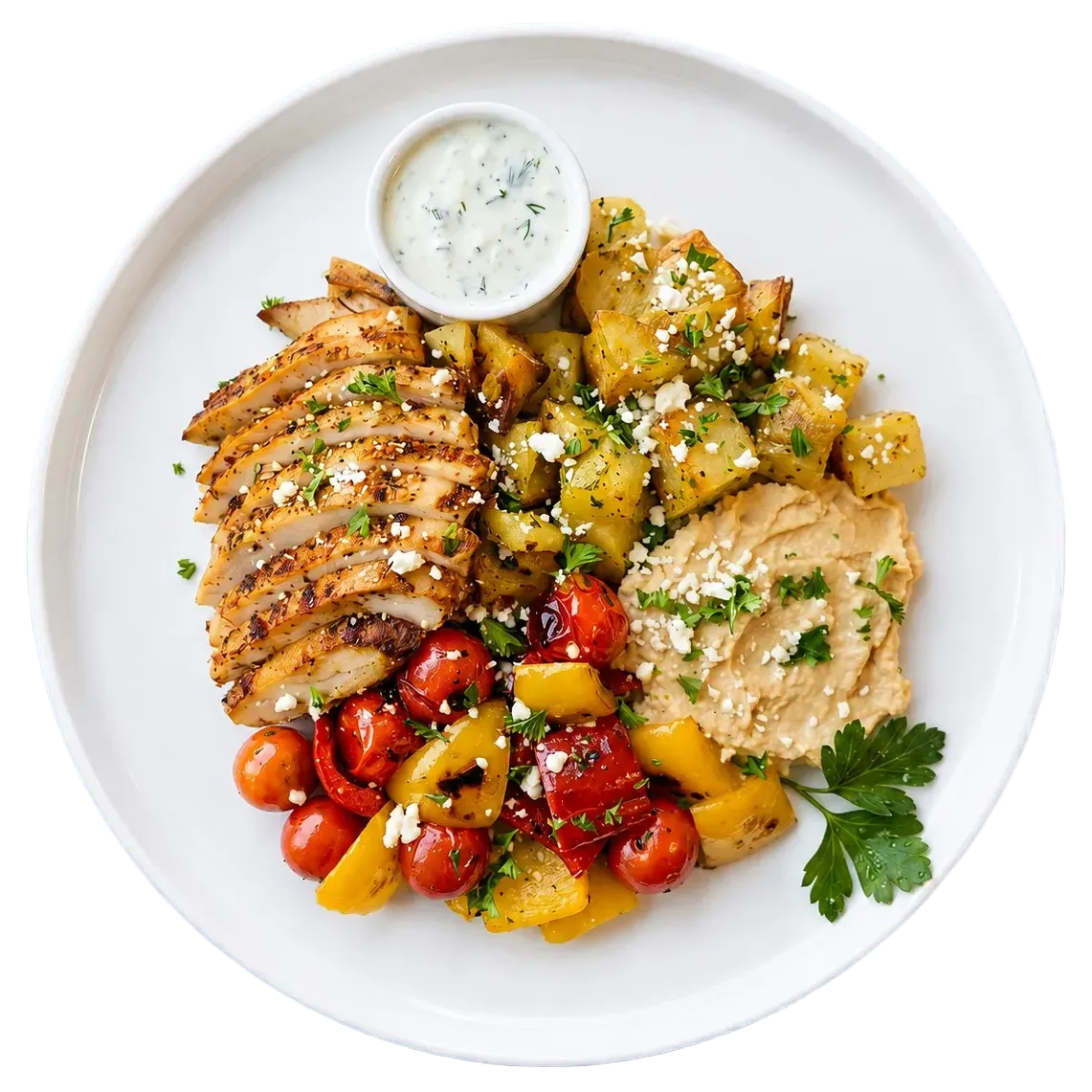
We keep our own labels simple. The kitchen rounds the grams first, then prints the calories as the plain 4, 4 and 9 total. On our Athens Almighty Chicken Souvlaki, 35 grams of protein, 40 of carbs and 30 of fat come to 140, 160 and 270 Calories, which adds up to the 570 on its label.
 AvailablePlant-Based
Your body doesn't absorb every calorie you eat
USDA researchers checked this with almonds. They fed people carefully measured meals, some with almonds and some without, and worked out how much energy their bodies actually absorbed. A serving of almonds gave people 129 Calories, not the 168 to 170 the rule predicts, which the researchers put at 32 percent fewer. Walnuts came in at 146 Calories an ounce, 21 percent under. Even how the almonds were prepared mattered. The rule overestimated whole raw almonds by 25 percent and chopped roasted ones by 17 percent.
So if a label's math comes up short, check the fibre line first and allow a little for rounding. Whatever's left comes down to Atwater's averages, and a body that never gets every last calorie out of an almond.

Sources
- 1IEEE Spectrum, Atwater's copper calorimeter, the bomb calorimeter, his 4.1 and 9.3, and turnips at 139 Calories a pound
- 2USDA AgResearch, Atwater as the father of nutrition research, the 4, 4 and 9 system, and the almond and walnut studies
- 3CFIA, elements of the Nutrition Facts table, The 4, 4, 9 and 7 factors, fibre at 2 Calories a gram, wheat bran at 0.6, fibre inside carbohydrate, and the 447 to 450 example
- 4CFIA, nutrition labelling compliance test, Every label value is a rounded number standing for a range
Read next
- Our five favourite nuts, and what to do with them
Five nuts, what each is for, and the storage mistake almost everyone makes.
- How to eat 30 plants a week without thinking about it
Thirty sounds like a lot until you find out that herbs, spices, nuts and grains all count.
- Leafy greens, and what they are actually doing
Spinach, kale, chard, collards and arugula, what each one is best at, and how to stop them dying in the crisper.
Rather not cook tonight?